How does music evolve?
SeraWorld
SeraWorld studies musical states, their relationships, and the consequences of change.
Inside SeraWorldExploring how music evolves.
And how we might create with it.
My research explores systems that model musical evolution and collaborate reliably with people across long creative processes.
How does music evolve?
SeraWorld studies musical states, their relationships, and the consequences of change.
Inside SeraWorldHow should AI act on music?
SeraForge studies editing tools, project memory, and reversible workflows that preserve a composer's intent.
Inside SeraForgeAuthoritative score state, musical operations, and reversible patches.
Research takes shape through instruments, software, and experiments. A selection from the Sera ecosystem.
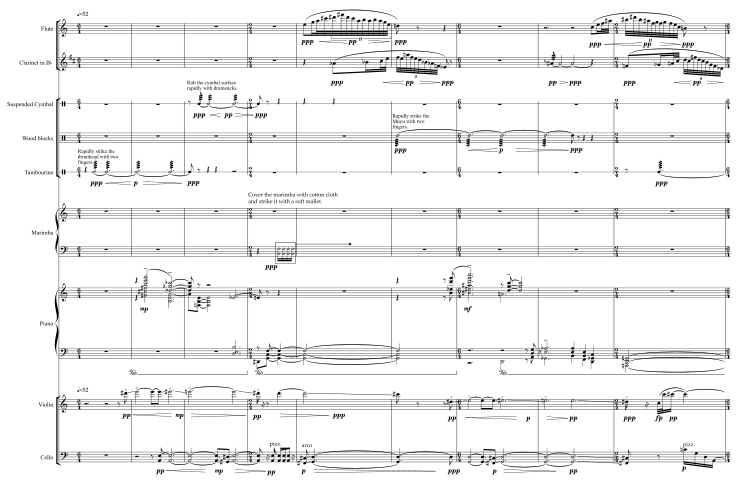
For small chamber ensemble
Follow a real edit from an instruction to a validated score revision. Explore six recorded examples from the offline software demonstration.
Recorded software execution. The walkthrough replays saved results; it does not call an AI model.
Download evidence ↗Address measures, staves, voices and individual events. Bind every proposal to the score it was created for.
SERAEDIT / SERA CORERetain project memory and lock musical properties, such as a motif's rhythm, across an editing session.
SERAFORGEReview differences, validation results and candidate alternatives before accepting a reversible change.
SERAFORGE / SERA COREStudy how timing, voice and context affect the predicted consequences of an edit, including when to abstain.
SERAWORLD / IN DEVELOPMENTA released research-software foundation, a manuscript in peer review, and two active lines of investigation.
Last documented status
A local-first editing system that turns language-guided proposals into bounded, validated changes, with explicit protection for the rest of the score.
Manuscript SOFTX-D-26-01135. Peer review is ongoing in the latest documented record; acceptance has not been reported. The offline demonstration checks software behavior and score round trips.
In a deterministic development probe, format repair improved local joint success from 80% to 84%. For transposition, intended-trajectory retention remained at 30% in both conditions.
The next challenge is preserving the cumulative musical goal across many edits.
September 12, 2026 · 18 sessions × 100 steps; 3 synthetic layouts from one generator family. Each condition used two previews per turn. No live LLM comparison or human study. Safety gates still accepted some valid but wrong-value edits.
The current prototype models the consequences of changes with event timing and voice context. Work-separated calibration tests examine how much of that prediction can be trusted.
Broad uncertainty intervals still limit useful coverage. The strict reliability gate has not passed.
September 10, 2026 · 10 new calibration works and 4 development-validation works passed source admission. Independence refers to this predictor's training and earlier calibration, not all historical project data. Multi-step planning and musical usefulness remain open.
SeraWorld models musical evolution. SeraForge studies reliable human–AI musical action. Both share authoritative score infrastructure through Sera Core; Forge can run independently of World.
Where the work stands, what remains open, and the questions that guide the next experiment.
Research snapshot · September 15, 2026. Milestones describe development progress, not published research findings.
I am interested in the space between musical imagination and intelligent systems.
Through the Sera research ecosystem, I explore how computational systems can understand musical change and support composers while keeping creative decisions in human hands.
This site brings together my research in progress, the tools that emerge from it, and a growing archive of musical work.
Follow the researchFor research conversations, software questions, or musical collaborations, you can reach me at any of these addresses.